
By Raihan Hazim Finance and Accounting Officer at Solve Education!
Before I joined, I assumed working at an NGO was just like working at any other organization, only without chasing profit. My first few days on the finance team changed that: the same number can mean very different things depending on who the money came from and what it is for.
An NGO (non-governmental organization) is an organization that is not part of the government and whose main goal is not profit but benefit to society. Solve Education! is a registered social enterprise that empowers young talents through behavioral science and technology to improve their earning potentials. One part of the group, Social Impact, is an NGO.
From the finance desk, I learned how an NGO really works. Here are four things I picked up, for anyone curious about the NGO world or thinking of joining it.
1. Money has a purpose from day one
In an NGO, funds often arrive as grants: money from a donor given for a specific purpose, which does not need to be repaid as long as it is used as agreed. These funds are usually restricted: they can be used for one program but not for other needs, even when the bank balance looks sufficient.
At first I was confused. If the money is there, why can't we use it? Over time I understood that a balance is not the same as freely usable money. Every rupiah carries a promise about what it will be used for.
Before asking "is the money there?", ask "what is this money for?"
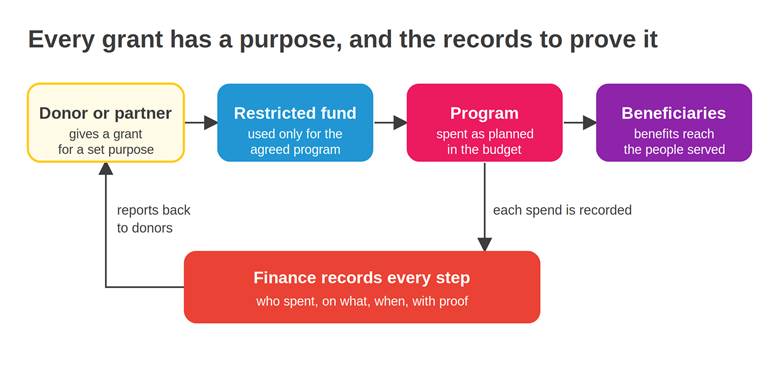
Follow one grant: it arrives with a purpose, is spent only on that purpose, and leaves a trail of records that leads back to the donor.
2. We are accountable to many parties
A company usually reports to its owners or shareholders. An NGO reports to many parties at once: donors, partners, auditors (independent parties who examine financial records), and ultimately the communities we serve. Each donor may have a different report format and schedule.
This means one transaction may need to be reported in different ways to different parties. I learned to record it once, neatly, so it can be reported many times without starting from zero.
Record once, correctly, so you can explain it many times to anyone.
3. Success is not measured by profit
An NGO has no "big profit this month" report. What we look at is whether funds were used as planned (the budget) and whether the benefits reached the beneficiaries. A surplus is not the goal, and leftover funds also need to be explained, not just celebrated.
I also learned about supporting operational costs, such as the finance team's salaries, systems, and administration. These costs are often seen as "not for the program." Yet without a team and systems that keep the records, programs are hard to run and hard to account for.
Efficiency in an NGO is not about cutting costs as low as possible, but about making sure every cost supports impact.
4. Trust is the biggest asset
Donors and partners give funds because they trust us. That trust is not built through slogans, but through clear, traceable records: who spent, on what, when, and what the proof is. That is why a small discipline like keeping receipts on time may feel trivial to some, but it means a great deal to the finance team.
A tidy record today is the answer we are ready to give when someone asks six months from now.
In an NGO, trust is built from small things that can be proven.
For those new to NGOs
If you are new to the NGO world or considering it, these three questions help me make sense of almost every financial matter here:
- What is this fund restricted for?
- Who will receive the report?
- What is the proof if someone asks?
For me, working in NGO finance turned out to be more than handling money. It is about keeping faith with the people who entrust their resources for the benefit of learners.
In an NGO, money is not the goal but a trust that must be explainable to everyone who entrusted it.